
Ubu
Drafts from the record. A person still Accepts.
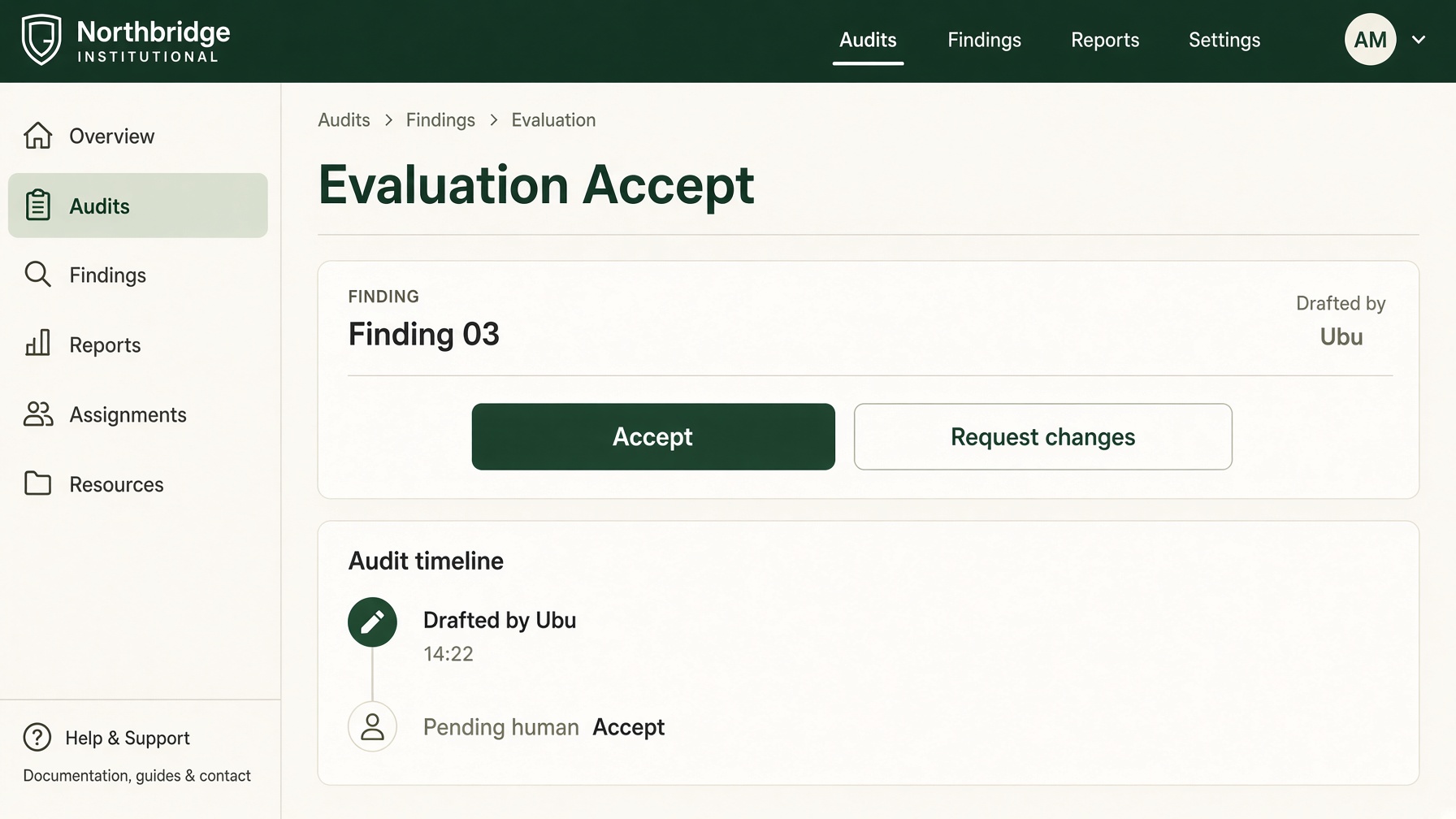
Not a chatbot. Ubu is the agent in the workflow. Drop a TOR, a field note or a receipt. Ubu does the plumbing against live records. You tap Accept. Nothing publishes as truth on its own. Guardrails are the product.
How it is built
Built on your live record
Ubu drafts from the people, programmes, evidence and TOR already in the tenant — not a stale export, not a blank page.
Specialised, not generic
Embedded in evaluation, MERL and claims workflows. Trained on the work of close-out, not on the open internet as a parlour trick.
You stay in control
Every material action is reviewable. Accept is logged. Edit before you sign. Judgement stays human.
Your close-out should not be a project
The old way versus IMP
The usual next step
- The next step is always a blank document.
- Someone spends Friday formatting what the records already knew.
- Draft and final get confused. Nobody can say who signed off.
- When the person leaves, the method leaves too.
The IMP next step
- Ubu drafts from what you already dropped in — TOR, field note, receipt.
- Gaps are flagged before the deadline: missing files, incomplete consent, pending Accepts.
- Accept is the control. The trail shows who drafted and who Accepted.
- The organisation keeps the method in the workspace, not in one person’s head.
What is actually in the product
Live workspace capability — not a roadmap dressed as a feature list. The ceiling is published on the same page as the capability.
In the workspace today
- Drop a TOR — Ubu drafts evaluation design and findings from live records
- Drop a field note — Ubu drafts the next structured entry
- Drop a receipt — Ubu reads it, flags a gap, drafts the claim step
- Human Accept before anything is published as truth
- Audit timeline of draft versus Accept
- Gap flags: missing files, incomplete consent, pending Accepts
Honest ceiling
- Not a chatbot bolted onto a dashboard
- Not an autonomous evaluation engine
- Not a replacement for independent advisory judgement
Built to handle the messy reality
Ask the record
Ubu drafts from what you already have. The answer is sourced from the tenant, not from a generic model with no context.
Flag the gap
Missing files and incomplete consent surface before the deadline. Continuous readiness, not a close-out fire drill.
Human Accept
A person signs. Nothing is published as truth without it. That is the golden rule of the product.
Pack from live records
You argue the finding, not the folder. The pack is an output of accepted work.
What Ubu does in practice
Hit Ubu, drop the work, fly — after a human says yes.
- 01
Drop the work
A TOR, a field note, a receipt — the raw material you already have.
- 02
Ubu drafts
The next design, finding or pack. Plumbing, not judgement.
- 03
You Accept
A person signs. Nothing is published as truth without it.
- 04
The trail remains
Who changed what, who consented, who Accepted.
From fire drills to a live record
Evaluator
From
Blank page against a TOR
To
A draft from live records
MEAL lead
From
Formatting until midnight
To
Argue the finding, not the folder
Leadership
From
Unsure what is still a draft
To
Accept is visible
Questions buyers actually ask
- Is Ubu an autonomous evaluation engine?
- No. Ubu drafts. Humans Accept. IMP is not a replacement for independent advisory judgement. This boundary is non-negotiable in the product.
- What can I drop in?
- A TOR, a field note, or a receipt. Ubu reads it, flags gaps, and drafts the next step against the live workspace.
- How is this different from a chatbot in the sidebar?
- Ubu is embedded in the workflow — evaluation, claims, readiness — connected to the tenant’s records. A chatbot that cannot Accept, and cannot be audited, is not an operating control.
Explore more of IMP
The work stays when people leave
Don’t wait for the laptop to be on a plane. Brief the cycle the way you would brief a successor.
Already have the note? Tell us about this cycle — we price from that.