
Close-out & residual capacity
Close-out becomes confirmation, not construction.
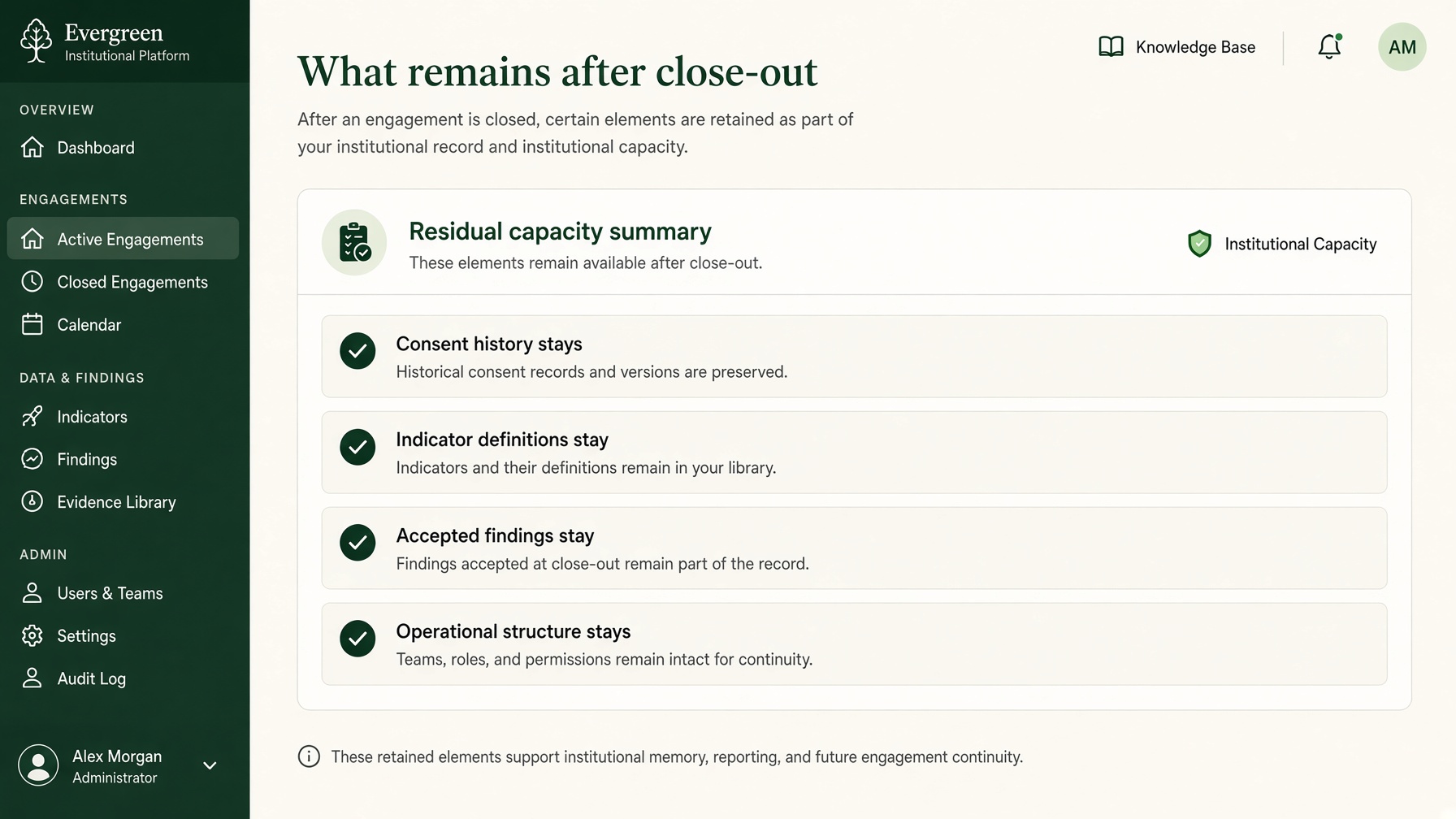
Most systems are built for the life of a project. IMP is built for what happens after. Consent history, indicators, accepted findings and the operational structure stay with the organisation. A new firm onboards onto your historical layer — not theirs.
How it is built
Keep the trail current
Consent, evidence, actuals and claims accumulate as you work. Readiness is continuous, not a two-week project at the end.
Accept along the way
Findings and packages are signed when they are true — not the night before the board.
Leave the structure
The organisation still holds the work when the project — or the consultant — ends.
Your close-out should not be a project
The old way versus IMP
The usual close-out
- People leave, files leave.
- Evidence is scattered across laptops.
- The board pack is assembled by hand.
- Nobody is sure what was accepted, or what is still a draft.
IMP residual capacity
- The trail is kept current during the work.
- Accepts are already on the record.
- Residual capacity is a checklist: evidence completeness, consent coverage, pending Accepts.
- A new firm can onboard onto your historical layer — not theirs.
What is actually in the product
Live workspace capability — not a roadmap dressed as a feature list. The ceiling is published on the same page as the capability.
In the workspace today
- Consent history that survives staff turnover
- Indicator definitions and results on the programme
- Accepted findings and packages with audit timeline
- Operational structure of the workspace — programmes, roles, evidence
- Readiness view: evidence completeness, consent coverage, pending Accepts
- End-of-pilot summary extract on IMP Pilot: exports + what the system now holds
- Client handback posture — a governed trail, not a personal Excel file
Honest ceiling
- Not a promise that field phones will sync themselves (offline mobile is not in product yet)
- Not automatic re-award — a trail is a stronger position, not a guarantee
- Not a data escrow marketplace between organisations
Built to handle the messy reality
Faster donor cycles
Convert field data into compliant reports in days instead of weeks — because the trail already exists.
Stronger re-award position
Prove outcomes with a trail donor agencies can actually follow, rather than a reconstructed annex.
Zero consultant lock-in
Onboard new staff or a new firm on your historical data layer — not theirs.
Continuous readiness
See evidence completeness, consent coverage and pending Accepts before someone asks.
What residual capacity looks like in practice
What remains after close-out is the product. That is the category IMP is in.
- 01
Keep the trail current
Consent, evidence, actuals and claims accumulate as you work.
- 02
Accept along the way
Findings are signed when they are true — not the night before the board.
- 03
Readiness
See evidence completeness, consent coverage, pending Accepts.
- 04
Leave the structure
The organisation still holds the work when people leave.
From fire drills to a live record
Country director
From
A scramble every close-out
To
Confirmation against a live record
Funder
From
Waiting weeks for a compliant pack
To
Days, because the trail already exists
New implementer
From
Starting from zero
To
Onboarding onto the organisation’s layer
Questions buyers actually ask
- What actually stays?
- Consent history, indicator definitions and results, accepted findings and packages, and the operational structure of the workspace — programmes, roles, evidence. That is residual capacity.
- Does this help re-award?
- It puts you in a stronger position. A trail donor agencies can follow is a better re-award file than a reconstructed annex. It is not a guarantee of award.
- How does a 90-day sandbox prove this?
- IMP Pilot is time-boxed: success criteria, first evaluation and learning entries, and a closing pack that shows what the system now holds. The workspace remains yours after the window.
Explore more of IMP
The work stays when people leave
Don’t wait for the laptop to be on a plane. Brief the cycle the way you would brief a successor.
Already have the note? Tell us about this cycle — we price from that.