
People & consent
Consent that survives a review.
Register the people you serve. Record consent by purpose. Enrol them in the programme they are actually in. The organisation owns the record — not a consultant laptop, and not a field officer spreadsheet.
How it is built
Purpose, not a checkbox
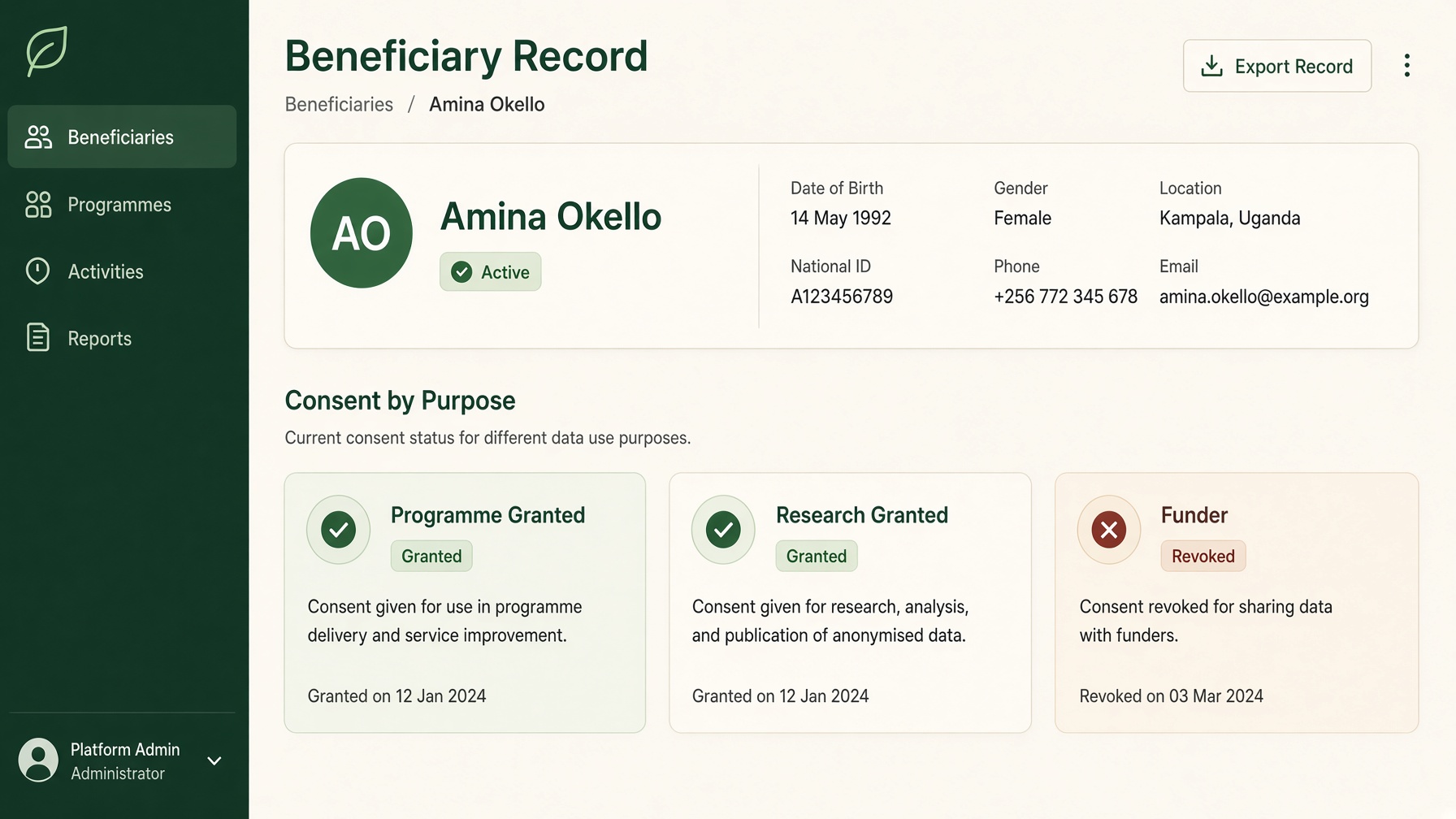
Consent is granted and revoked for Programme, Research, Funder or Partner use — dated, on the person, reviewable.
Organisation-owned
The register sits inside the tenant. When staff leave, the list does not leave with them.
Enrolment is explicit
People join, leave and re-join programmes on the same record. Coverage is not a parallel sheet.
Your close-out should not be a project
The old way versus IMP
The usual register
- Names live in a field officer’s spreadsheet, or a consultant workbook nobody else can open.
- Consent is a single checkbox, or a scan in a folder that cannot be found at review.
- When staff leave, the list leaves with them — and so does the history of who said yes.
- A donor asks who consented to research use. Nobody can answer without reconstructing email.
The IMP register
- Every person sits in an organisation-owned workspace, with contact and demographics enough to serve.
- Purpose badges — Programme, Research, Funder, Partner — with grant date and revoke history.
- Enrol, unenrol and re-enrol against the programme they are actually served by.
- Consent coverage is a report, not a reconstruction. Review opens the record.
What is actually in the product
Live workspace capability — not a roadmap dressed as a feature list. The ceiling is published on the same page as the capability.
In the workspace today
- Beneficiary profiles with contact and demographics — enough to serve, not a data dump
- Purpose-based consent: Programme / Research / Funder / Partner
- Grant date and revoke history on each purpose
- Enrol / unenrol / re-enrol against a programme
- Consent coverage on the reports page (IMP MERL)
- CSV export of the register
- Import path for spreadsheet-first teams (templates + column mapping)
Honest ceiling
- Not a national ID registry or civil-registration system
- Not a full IRB / ethics-committee legal portal
- Not an offline household census or HMIS
Built to handle the messy reality
Register
Name, contact, demographics. One record the organisation holds. Duplicate handling is part of import, not a weekend in Excel.
Consent by purpose
Four purposes, independently granted or revoked. A single yes/no is not consent-aware operations.
Enrolment
The person and the programme meet on the same record. Coverage at close-out is a query, not a rumour.
Review
Open the person. See what was granted, when, and by whom. That is the trail a compliance officer can stand behind.
What consent looks like in practice
One person. Four purposes. A history the organisation can take to a review.
- 01
Register
Create the person in the tenant — not in a private workbook.
- 02
Purpose
Grant or revoke Programme, Research, Funder or Partner use.
- 03
Enrol
Link them to the programme they are actually in.
- 04
Review
Open the record. The history is already there.
From fire drills to a live record
MEAL lead
From
Chasing lists across country offices
To
One consent-aware register
Field coordinator
From
Re-typing the same names
To
Enrolment on the live record
Compliance
From
Hoping the scanned form still exists
To
Purpose history, ready for review
Questions buyers actually ask
- Is consent a single yes or no?
- No. IMP records consent by purpose — programme delivery, research, funder reporting, partner sharing — with grant and revoke, dated. A checkbox is not a history.
- Can another organisation see our people?
- No. Each organisation is a separate tenant. People records and consent never leak across workspaces.
- Can we bring existing lists?
- Yes. Spreadsheet-first teams import history with templates and column mapping instead of retyping it. Duplicate handling is part of that path.
- Is this a national identity system?
- No. IMP is a programme workspace. It is not a national ID registry, civil registration, or offline HMIS.
Explore more of IMP
The work stays when people leave
Don’t wait for the laptop to be on a plane. Brief the cycle the way you would brief a successor.
Already have the note? Tell us about this cycle — we price from that.