
Finance & operations
Claims and vendors under the same policy as the work.
Finance should not have to chase programme codes at month-end. IMP holds staff claims and vendor invoices next to the programmes they support. Approvals are in the workspace. Payment stays in the ledger you already run.
Read isolation before you put claims on a tenant.
Organisation is the controller. IMP is the processor. Files never mix. Hosting is a design question, not a footnote.
The problem you feel
Receipts in email. A finance system that does not know the logframe. Vendor bills chasing a project code that changed last quarter. Audit becomes archaeology. Programme and finance only meet when it is too late.
What you stop doing
- Chasing programme codes after the fact
- Reconciling receipts from email
- Explaining to auditors why the trail lives in three systems
- Discovering unmapped spend at close-out
What you get
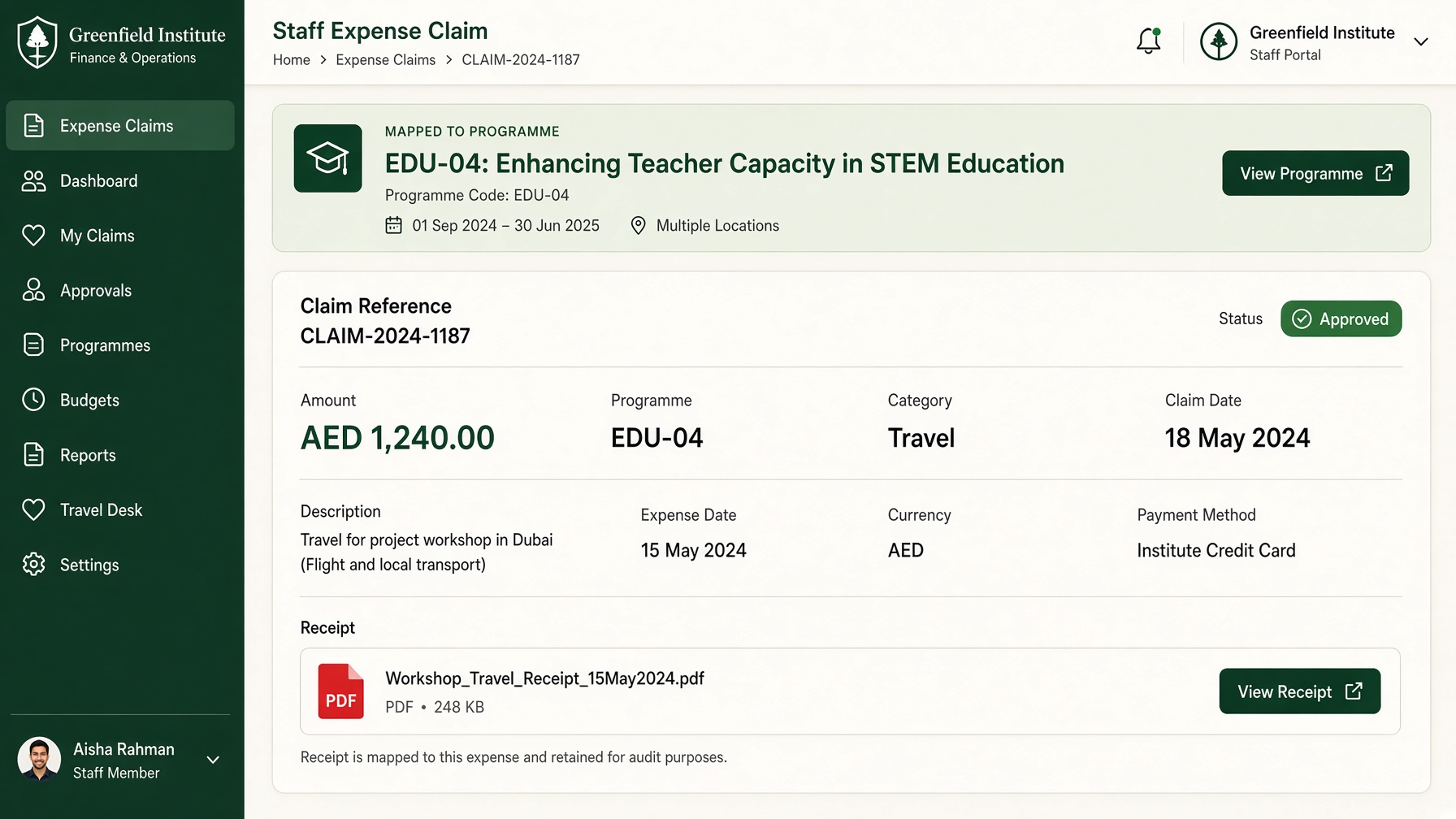
- Staff claims mapped to programme and cost centre
- Vendor invoices with line items and approval trail
- Receipts on the record — Ubu can read a file and flag a gap
- Submitted / approved / rejected with who and when
- Audit as a download, not a reconstruction
- No auto-pay — humans own payment outside IMP
A week on IMP
A claim comes in
It already names the programme and cost centre. The receipt is attached. If something is missing, Ubu has flagged it.
Month-end
Export the mapped trail. Reconcile into NetSuite, SAGE or the treasury process you already have. IMP is not pretending to be the GL.
Audit
Sample from a downloadable trail tied to the work, not from a box of printed receipts and a shared drive.
The shift
Month-end
From
Triangulation
To
A mapped export
Audit
From
Sampling folders
To
A trail that already exists
How this is usually bought
Finance is EMS-light — real operational claims, not an ERP. Request / invoice only: MERL Workspace Diagnostic USD 1,500 or IMP Evaluation Assignment USD 4,500. We will not sell it as a NetSuite replacement. The organisation is the data controller. IMP is the processor.
Questions for this seat
- Does this replace our ERP?
- No. IMP sits upstream: operational claims and vendor bills tied to programmes. Payment and the general ledger stay where they are.
- Who approves?
- Your policy. Status is submitted, approved or rejected, with who and when. IMP never auto-pays.
- Who is the data controller? Where does data sit?
- The organisation is the controller. IMP is the processor. Each organisation is its own tenant — people, consent, claims and files never leak across tenants. Hosting is named on the invoice request: shared cloud, regional (Africa / South-East Asia), or sovereign-isolated. The last is an engagement option, priced honestly, not a silent default.
Read isolation before you put claims on a tenant.
Organisation is the controller. IMP is the processor. Files never mix. Hosting is a design question, not a footnote.
Already have the note? Tell us about this cycle — we price from that.