
Evaluation
Answers to the TOR — after a human Accept.
Drop the terms of reference. Ubu drafts the design and findings from live records. Nothing becomes a board pack until a person Accepts. Judgement stays with the team. OECD-DAC criteria sit next to the evidence, not in a consultant slide deck rebuilt at the end.
How it is built
The TOR sits on the engagement
The questions the evaluation must answer live in the workspace — not in an email that got archived.
Drafts from the record
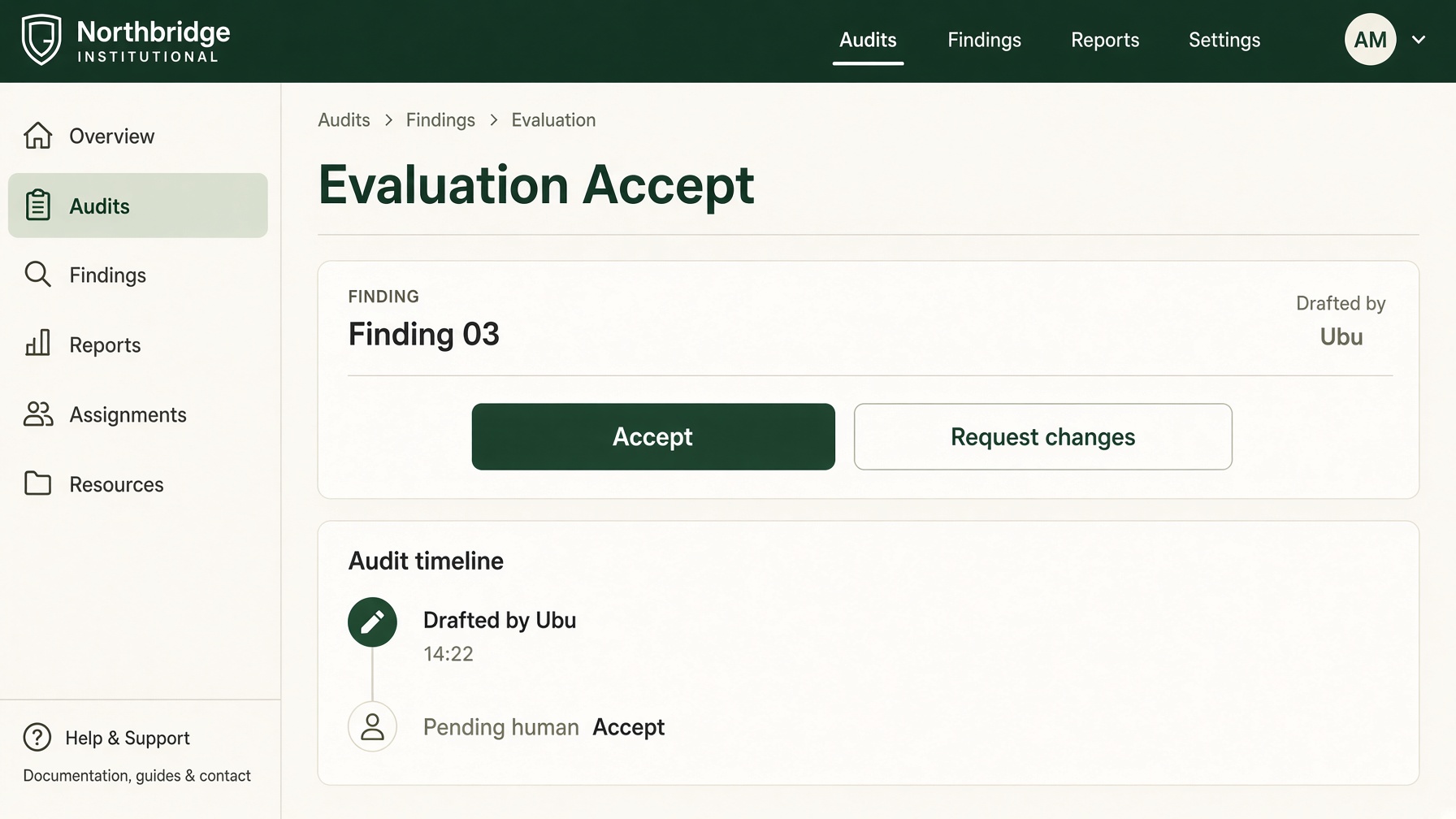
Ubu drafts from field notes, people, results and the TOR. It does not invent a finding, and it does not publish one.
Accept is the control
Nothing client-facing becomes truth without a human gate. The trail shows who drafted and who Accepted.
Your close-out should not be a project
The old way versus IMP
The usual evaluation
- The TOR lives in email. The design lives in a Word file. The findings live in a consultant draft.
- OECD-DAC criteria are rebuilt in a slide deck at the end.
- Nobody can say who signed off what, or what is still a draft.
- When the evaluator’s contract ends, the method leaves with them.
The IMP evaluation
- The TOR sits on the engagement. Genre kits exist for ETR multi-country, IRB/pilot, and generic evaluation.
- Path: TOR → Accept design → inception → field → draft evaluation → pack Accept.
- Relevance, coherence, effectiveness, efficiency, impact, sustainability sit next to the evidence.
- Accept is logged. Residual capacity stays with the commissioning organisation.
What is actually in the product
Live workspace capability — not a roadmap dressed as a feature list. The ceiling is published on the same page as the capability.
In the workspace today
- Evaluation records: Baseline / Midline / Endline / Ad-hoc with status, findings, recommendations
- TOR on the engagement; Ubu drafts design and findings from live records
- Human Accept with audit timeline — who drafted, who Accepted
- OECD-DAC six criteria held next to evidence and findings
- Board pack as an output of accepted findings, not a parallel document
- Evaluation workhorse playbook (primary product moat)
- Partial IRB / measurement-pilot playbook — ethics holds and structure, not a full legal committee package
Honest ceiling
- Never a zero-human evaluation engine — IMP drafts; humans Accept
- Not advanced quasi-experimental statistics
- Not a full IRB / legal committee portal
Built to handle the messy reality
Drop the TOR
The questions the evaluation must answer — in the workspace, on the engagement.
Ubu drafts
Design and findings from field notes, records and the TOR. Plumbing, not judgement.
You Accept
A person signs. Methodology and the finding stay with professionals. The trail is the product.
Pack
The board pack comes from accepted findings. Close-out is confirmation, not construction.
What evaluation looks like in practice
TOR in. Draft out. Human Accept. Trail intact. Residual capacity with the client.
- 01
TOR
The questions the evaluation must answer — in the workspace.
- 02
Draft
Ubu drafts design and findings from the records you already have.
- 03
Accept
A person signs the judgement. Nothing publishes as truth on its own.
- 04
Pack
The board pack is an output of the record, not a last-week scramble.
From fire drills to a live record
Evaluator
From
Rebuilding the evidence chain in Word
To
Argue the finding, not the folder
Commissioner
From
Unsure what was draft versus final
To
Accept history on every package
Board
From
A pack assembled by hand
To
Answers with a trail
Questions buyers actually ask
- Does Ubu decide the evaluation?
- No. Ubu drafts. Humans Accept. Methodology and judgement stay with professionals. This is a hard product boundary, not a slogan.
- Can this support OECD-DAC reporting?
- Yes. The six criteria sit next to evidence and findings in the record — not rebuilt later in a consultant deck.
- What happens when the evaluator’s contract ends?
- The organisation keeps the TOR, the evidence, the accepted findings and the pack structure. Residual capacity is the point of the product.
Explore more of IMP
The work stays when people leave
Don’t wait for the laptop to be on a plane. Brief the cycle the way you would brief a successor.
Already have the note? Tell us about this cycle — we price from that.